
On-Kid Team Wins Excellence Award at AI Hack Camp 2026
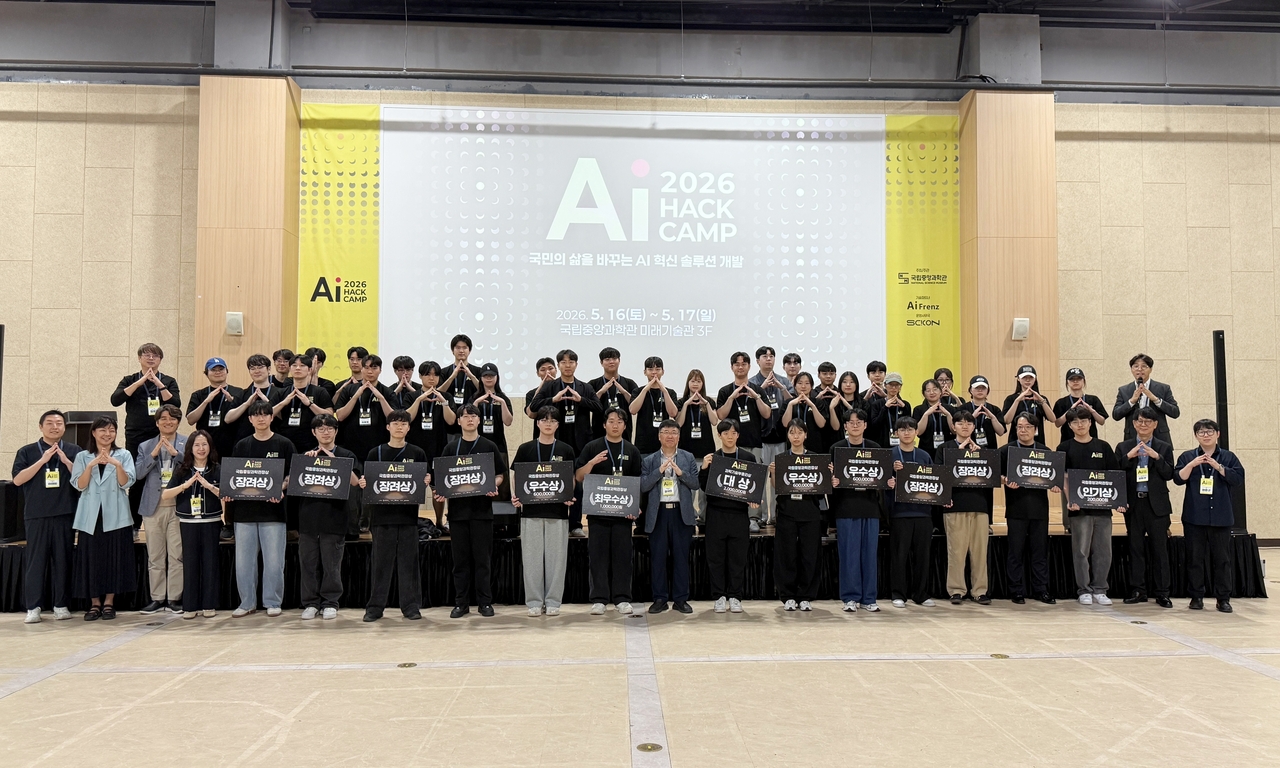
AI Hack Camp 2026 winning teams gathered at the National Science Museum's Future Technology Hall on May 17 to celebrate. Provided by the National Science Museum.
The On-Kid team, including members from Hanbat National University, earned honors at AI Hack Camp 2026 by creating a fairy-tale education solution that helps children with visual and hearing impairments learn language.
The National Science Museum announced on May 19 that the On-Kid team won first place in the digital education category and received the Excellence Award (National Science Museum Director's Award) at the AI Hack Camp 2026 awards ceremony held at the Future Technology Hall on May 17.
The fairy-tale education solution submitted by the On-Kid team was designed so that children with hearing and visual impairments can learn language through the same content, using multiple sensory and expressive methods such as subtitles, sign language, audio, and scene descriptions.
The solution also includes personalized learning features that allow AI to adjust the learning difficulty in real time based on user responses and answer accuracy. It was well received as an educational model that helps reduce literacy gaps for children with disabilities.
The Grand Prize (Deputy Prime Minister and Minister of Science and ICT Award) at AI Hack Camp 2026 went to the DevFive team (DevFive Inc., digital inclusion category), which developed a conversational AI service that helps older adults and people with disabilities easily create HWP documents using voice, photos, and handwriting. The Excellence Prize (National Science Museum Director's Award) went to the CSI team (Hanshin University and others, digital health category), which presented a system that monitors patient conditions in real time using Wi-Fi signals and on-device AI without cameras or sensors.
The AI Deepfake Hunters team (Gachon University and others) created a voice-phishing security program, while the Sregeetong team (Korea University and others) implemented a service that guides mobility-impaired users to optimal accessible routes. The two teams received Excellence Awards in the digital safety and digital inclusion categories, respectively. In addition, seven teams, including Fundus2OCT (UNIST and others), received Encouragement Awards (National Science Museum Director's Award).
This year's competition was held under the theme of “developing AI innovation solutions that change people's lives.” A total of 410 teams participated, including 122 teams in digital inclusion, 107 in digital education, 93 in digital safety, and 88 in digital health. The National Science Museum selected 12 winning teams, three from each category, by combining expert evaluation (70%) and public voting (30%).
Kwon Seok-min, director of the National Science Museum, said, “This competition is meaningful because citizens directly participated as ‘co-existence designers’ in the AI era and envisioned the future together. We hope the solutions developed through the competition will become a starting point for filling blind spots in our society and improving quality of life.”